» Trekking in Nepal  
  » Mountain Expedition  
  » Peak Climbing  
  » Short and easy trekking  
  » White Water Rafting  
  » Tour Packages  
  » City Tours  
  » Jungle Safari  
  » Mountain Biking  
  » Hiking Around Kathmandu  
  » Adventure Sports  
  » Hotel Booking  
  » Ticketing  
  » Agro Tourism  
  » Cultural Tourism  
  » Village Tourism  
  » Eco Tourism  
  » Pilgrimage Tourism  
  » Recreational Fishing  
  » Bird Watching  
  » Honey Hunting  
   
  » General information on Nepal  
  » People and culture  
  » Visa and Permit  
  » Climate  
  » Money and Banking  
  » Message from board of    directors  
  » General information on    Trekking  
  » Trekking equipments  
  » Climbing equipments  
  Other Destinations  
  » Nepal  
  » Tibet  
  » Bhutan  
  » India  
Home   |   About us    |   Photo gallery   |   Online Booking   |   Contact us
 
TREKKING IN NEPAL : EVEREST REGION


Everest Short Trek : 08 days

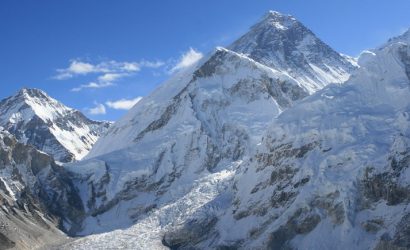
The name “Everest” is magic in itself. Everest (8848m.) is called “SAGARMATHA” in Nepali – “Higher than the Sky” and “CHHOMOLUNGMA” in Tibetan – “Mother Goddess of the Earth”.

The Mount Everest or Solu Khumbu region is one of the most popular trekking areas in Nepal - tinged with the romance of being so close to the highest mountain in the world. The route lies in the highest wildlife reserve in the world, the Sagarmatha National Park. It covers an area of 1,148 square kilometers of Himalayan ecological zone. The park altitudes range from 2,845m at Monju to the top of the world, UNESCO listed the park as a World Heritage Site in 1979 for its unique natural, cultural and landscape characteristics.

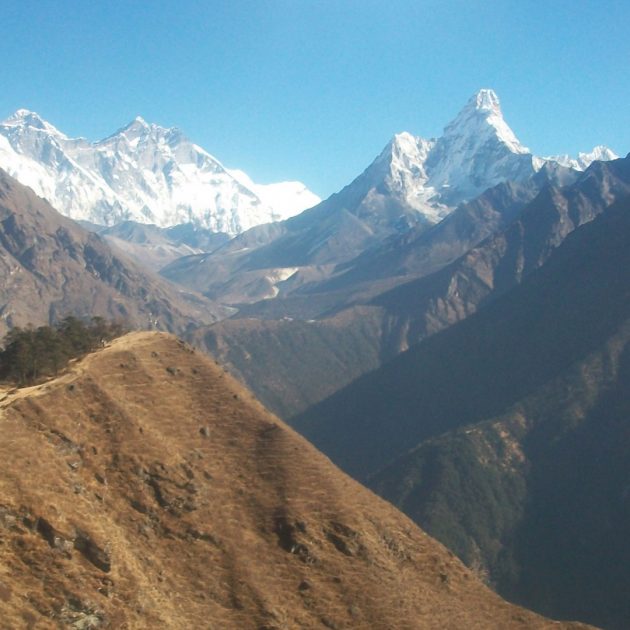
A trek in this region follows the course of the Dudh Kosi, the ‘River of Milk’, gradually climbing through forests of rhododendron and magnolia. It takes one to the foothills of the mightiest of the mountains in the world. En route, one traverses through rhododendron and pine forests, rivers, Sherpa villages and Buddhist Monasteries from temperate to snow line regions. The Himalayas are best seen on this trek as one traces the main route through the Khumbu region from the Sherpa town of Namche Bazaar. Trekkers get a close view of the world's greatest mountains, Everest, Lhotse, Nuptse, Ama Dablam, Thamserku, Tawache and many other unnamed mountains and peaks.

For the people of this exotic region, the hard grind in the daily life in the high Himalayas is interrupted by seasons of feasts and festivals, marked by dancing and general merry making. Most festivals are of religious nature and centre on the temples and monasteries, with rites conducted by lamas (priests). These festivals are spread out through the full moon days of May, June, July, August and November in different sections of the Himalayas. While the Sherpas are the most predominant people of Solukhumbu, in the lower region of Solu, the Khaling Rai culture prevails as well. In Khumbu where agriculture land is limited, livestock raising and trade is more important, while Solu with less severe winters grows a variety of staple crops.

 
Facts of the Trek
Duration: 08 Days
Trek type: Tea House
Max Altitude: 3867 m.
Minimum Pax: 1 +
Mode of travel: Flight
Grade: Moderate
 

DDay 01: Fly from Kathmandu to Lukla (2886m.) and it takes about 30 minutes. Trek from Lukla to Phakding (2640 m.) which takes approximately three hours.
You transfer to the domestic airport for your flight to Lukla. Lukla is a small town with an airport. There are few tea shops, lodges, hotels and general stores. You begin today’s trek from Lukla following a gentle climb up the mountainside on the left bank of the Dudh Koshi river. Nupla (5885m) can be seen in the distance on the opposite bank, is a peak atop the Kongde Ridge. You descend a mountainside path that merges into your route to Everest, with views to a valley to your right; and at its far end, Kusum Kang (6367m.) The Dudh Kosi approaches as you pass a Mani wall and arrive at Ghat teahouse. You continue along a small path with many climbs and descents following the left bank of Dudh Koshi to Phakding.

Day 02: Trek from Phakding to Namche Bazaar (3440 m.) and it takes approximately five hours. The trail starts along a level path along the right bank. Thamserku looms skyward on the opposite bank. You cross a stream and climb the terraced hill from the Dudh Koshi route, to arrive at Bengar. The trail now climbs from the riverbed on the left bank into the mountain, through a forest to Chumoa. You continue along a path with many ups and downs; cross a stream, and pass by the tiny village of Monjo. Now you descend the path of stone steps and return to the right bank over a wooden bridge. After a short climb you come to Jorsale’s teahouse and hotel, also stop at the National Park Service where a park entrance fee is collected. After your departure from Jorsale, you enter a forested mountainside. You follow a short walk along the riverbed of this V-shaped valley where the river forks - the right is the Dudh Koshi and the left is the Bhote Koshi that leads to Nampa La. After short distance along the Bhote Koshi, begin the steep ascent to Namche Bazar. As the mountain path zigzags uphill, you will emerge at a ridge top rest area that offers excellent views of Everest (8848m) and Lhotse (8516m.) The climb eases somewhat, and Namche Bazar appears ahead as you travel along the path surrounded by pines. Pass the plateau where the Saturday bazaar is held and enter the village. Namche Bazar (3440m) is surrounded on three sides by mountain ranges and opens out only where it faces the Bhote Koshi. The village is a central hub of the area and food, sundries and even mountain climbing equipment may be purchased here

Day 03: Rest day at Namche Bazaar (3440 m.) for acclimatization. Namche is tucked away between two ridges amidst the giant peaks of the Khumbu and has an abundance of lodges, tea shops and souvenir shops as well as a magnificent outlook. It is an ideal place to spend a rest day for acclimatization to the high altitude before heading off towards Tyangboche. For the acclimatization you walk upto Khhumjung where you can visit monastery. Khhumjung is densely populated by Sherpa community. You can also enjoy the splendid views of Everest, Ama Dablam, Thamserku, Nuptse, Lhotse, Tawche, Kwangde and so on. Or you can have an hour walk up to the Syangboche (3800m.) where Everest View Hotel is situated above Namche for the outstanding view of Everest, Nuptse, Lhotse, Ama Dablam, Thamserku and Kusum Kangaru. .There is also good views from the National Park Centre and Museum just above the town. This museum exhibits Sherpa culture. 

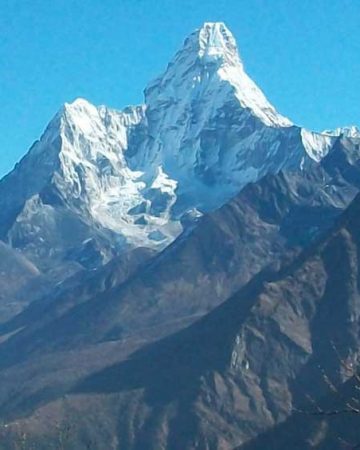
Day 04: Trek from Namche Bazaar to Tyangboche (3867m.) which takes approximately five and half hours. From Namche, you climb towards the park headquarters and follow a contouring trail high above the Dudh Koshi River. Above Namche the route to Thyangboche becomes visible with the monastery seen below the summit of Everest and surrounded by Himalayan peaks. On today’s walk there are opportunities to spot the local wildlife, including the beautiful Danphe Pheasant often seen among the birch and silver fir forest between Shanasa and Trashinga, and Himalayan Thar on the high ground above the trail. After reaching the re-forestation nursery at Trashinga, the trail drops steeply to cross the Dudh Koshi at Phunkitenga (3250m), where you take lunch. In the afternoon you pass water-driven prayer wheels and ascend, initially steeply, through pine, fir, black juniper and rhododendron forest towards Thyangboche. The monastery and lodge are located in a beautiful meadow surrounded by towering Himalayan peaks in a truly peaceful and tranquil setting. The most notable peaks seen from here are Kantega, Ama Dablam (perhaps the most beautiful peak in the region) and, of course, mount Everest.

Day 05: Trek from Tyangboche to Shanasa (3670m.) and it takes almost two and half hours.
In the 17th century AD, the Lama Sange Dorjee, from Tibet’s Rongbuk Monastery, according to legend, founded the monastery here. It was destroyed by an earthquake in 1933, rebuilt and again badly damaged by fire in 1989. Construction of the present monastery was completed in 1992.

You have a full morning at Thyangboche to visit the monastery and the nearby museum. There is a small entrance fee for the museum and a small donation to the monastery is appreciated. In the afternoon you retrace your steps down hill through the beautiful forest of juniper, rhododendron and fir to Phunkitenga. After you cross the Dudh Koshi, you ascend steeply to Trashinga. From here the trail contours high above the valley to Shanasa where you spend the night. Here Tibetan traders, resident in the area, have numerous ''artifacts'' and worthwhile traditional souvenirs for sale.

Day 06: Trek from Shanasa to Monjo (2835m.) which takes approximately five and half hours.
The villages of Kunde and Khumjung are only a short trek off the main trail and are well worth a visit. Khumjung has a beautiful monastery and Kunde has a small hospital run by Sir Edmund Hillary’s Himalayan Trust and you shall return to Namche via this route. The walk also heads past the Everest View Hotel and the Shyangboche airstrip before dropping into Namche where you take lunch. In the afternoon you descend steeply and then walk along the river bank back to Jorsale where you leave the national park before continuing on to your lodge at Monjo where you stay overnight.

Day 07: Trek from Monjo to Lukla (2886m.) and it takes about four hours. You re-trace your steps along the Dudh Koshi, crossing the western bank at Benkar. It is a beautiful and easy walk through blue pine and rhododendron forest, back-dropped with views of Kusum Kangaru. An early lunch will be taken at Phakding and in the afternoon you ascend out of the river valley back to the airstrip and you are offered lodge accommodation at Lukla. In the evening, a farewell dinner may be followed by a few celebratory drinks and dancing with Sherpa companions.

Day 08: Fly from Lukla to Kathmandu (1100m.) which takes almost 30 minutes. This morning you take a flight back to Kathmandu.

 
Services Included
National Park entry permit, Trekking permit, Land transportation to and fro, Accommodation in lodges during the trek, Food: three meals a day, A guide & required number of porter(s), Essential equipment.
 
Services Excluded
Personal expenses, Insurance, Tips, Emergency evacuation by Helicopter, Alternative transportation in case of heavy rain, landslide, strike, road blockade etc.
 
Everest Base Camp trek - 14   Everest adventurous trek
Duration : 14 Days   Duration : 19 Days
     
Everest Kalapatthar trek   Everest Cultural trek
Duration : 16 Days   Duration : 09 Days
     
EBC - Lukla - Kalapatthar - EBC   Everest Short trek
Duration : 17 Days   Duration : 08 Days
     
Everest Gokyo trek   Everest Gokyo trek
Duration : 12 Days   Duration : 13 Days
     
Jiri - Namche - Gokyo - Jiri   Jiri - EBC - Kalapathar - Lukla
Duration : 27 Days   Duration : 25 Days
     
Jiri - EBC - Kalapathar - Jiri   Jiri - Gokyo - Chola Pass - Kalapathar - EBC
Duration : 28 Days   Duration : 27 Days
     
Jiri - Gokyo - Lukla trekking   Jiri - Kalapathar - EBC - Lukla
Duration : 22 Days   Duration : 24 Days
     
Lukla - Namche - Gokyo - Lukla    
Duration : 12 Days    
     
 
Home   |   Trekking   |   Mountain climbing   |   Jungle Safari   |   Rafting   |   Sightseeing   |  Other activities  
 
FIRST ENVIRONMENTAL TREKKING (P.) Ltd.
Affiliated to:
P.O. Box: 8056 Thamel, Kathmandu, Nepal
KEEP NMA NTB TAAN HIMA RHINO
Tel: (+977-1) 4417343, 4424346, Fax: (+977-1) 4423855
E-Mail : firstentrek@wlink.com.np, 1envtrek@ccsl.com.np, info@firstetrek.com